

Not all packaging labelled as “sustainable” lives up to the claim. With regulators tightening rules, customers demanding transparency, and internal sustainability targets looming, the cost of choosing the wrong material has never been higher.
Let’s break down the most common options and what the evidence says about them.
The problem with conventional packaging materials
Plastic foam
Plastic foam (e.g. expanded polystyrene) is lightweight and protective, but its drawbacks are undeniable:
- Fossil-based: Made from petroleum, a non-renewable resource.
- Hardly recycled: Low collection rates (around 40% for plastic packaging in the EU) and contamination issues mean most EPS ends up in landfills or the environment, where it stays for hundreds of years.
- Poor circularity: Even in ideal recycling scenarios, plastic foam scores poorly on circularity metrics (e.g., only 46% circular under the Ellen MacArthur Foundation’s Material Circularity Indicator).
Cardboard and paper-based buffers
Paper-based packaging is often perceived as sustainable, but its impact depends on sourcing, recycled content, and real-world recycling rates. A recent NGO report (European Environmental Bureau, Zero Waste Europe, Fern, and others) exposes its hidden costs:
- Largest source of packaging waste in the EU: 32.7 million tonnes in 2020—more than plastic and glass combined.
- Drives deforestation: 90% of paper pulp comes from wood, and production accounts for 35% of all clear-felled trees globally.
- Often lined with plastics or chemicals (e.g., PFAS): this hinders recycling and poses health risks.
- Energy-intensive: The pulp and paper industry is one of the world’s most energy-intensive sectors, consuming 6% of global industrial energy and producing 2% of direct industrial CO₂ emissions.
- The paper industry’s environmental impact is significant: manufacturing one tonne of paper uses as much energy as producing one tonne of steel, and each kilogram requires 2.2 kg of wood, 5 kWh of energy, 50 litres of water, and 15 grams of chemical pollutants.
- Performance: Paper may not always match the protective qualities of EPS or Mycelium Packaging for fragile or high-value goods.
Bioplastics and Biodegradable Plastics
Bioplastics are sometimes marketed as a drop-in replacement for conventional plastics, meaning the fossil-based source is replaced by a renewable one. Biodegradable plastics take it a step further: they can be composted, but mostly only in industrial facilities.
- Drop-in bioplastics: Switching to a renewable source offers advantages to traditional plastics, it still comes with environmental impacts, such as high energy-use during processing and disposal, releasing microplastics and disrupting recycling, composting and landfilling systems.
- Biodegradable plastics: Many require industrial composting facilities, which are not universally available. Even when they are, these plastics often contaminate or disrupt the stream, leaving incineration and landfill as the only options.
Greenwashing risk: Claims of sustainability can be misleading. For example, consumers may be led to believe that biodegradable plastics can degrade in nature, while it requires specific composting facilities. And, bioplastics made from sugarcane often originate in South America, requiring long-distance shipping, which undermines their environmental benefits.
The right questions to ask about duurzame packaging materials
Almost every material on the market claims to be sustainable. The difference lies in the details. Here’s what to ask before committing:
1. What’s the realistic End-of-life scenario?
- Not the best-case scenario—the realistic one. What percentage of this material is actually collected, processed, and kept in the loop in your markets?
- A material that is technically recyclable but rarely recycled in practice is still linear, not circular.
2. Does it fit your compliance trajectory?
- The PPWR (Packaging and Packaging Waste Regulation) takes effect in August 2026, requiring all packaging to be recyclable by 2030. Any material you invest in now should align with this trajectory.
3. What does it mean for your sustainability reporting?
- Sustainability managers need reportable, verifiable figures. Choose materials with quantified and documented carbon impact to integrate seamlessly into your sustainability reporting.
4. What are the true cost implications?
- Upfront costs are just part of the picture. EPR (Extended Producer Responsibility) fees, which place the cost of waste collection and processing on producers, are tied to material choices. Switching to a lower-impact material can reduce EPR fees over time, offsetting part of the transition cost.
Why choose Mycelium Packaging?
At Grown bio, we’ve reimagined protective packaging. Our Mycelium Packaging is grown from mycelium (the root structure of mushrooms) and hemp fibres. The substrate is placed in custom moulds, where it grows into shape in just 6 days. The result is a material that’s home compostable, marine compostable, and industrially compostable.
Here’s how it stacks up against the tough questions:
End-of-life pathway
- Mycelium Packaging can be composted at home, in the garden, or via industrial facilities and no specialist infrastructure is required.
- Research using the Ellen MacArthur Foundation’s Material Circularity Indicator found that it scores up to 94% under composting conditions. By comparison, EPS reaches 46% even under ideal recycling scenarios.
Regulatory alignment
- Switching to Mycelium Packaging aligns with the PPWR’s emphasis on circularity and helps future-proof your strategy.
Carbon reporting
- Mycelium Packaging saves approximately 600g of CO₂ per litre compared to EPS.
- As a carbon-neutral material, this is a concrete, reportable figure you can plug straight into your emissions reduction targets and sustainability disclosures.
Cost trajectory
- As regulatory pressure increases and virgin plastic becomes costlier to use and dispose of, Mycelium Packaging becomes an even smarter investment.
- Lower EPR fees, combined with the reputational and commercial value of truly circular packaging mean the business case strengthens over time.
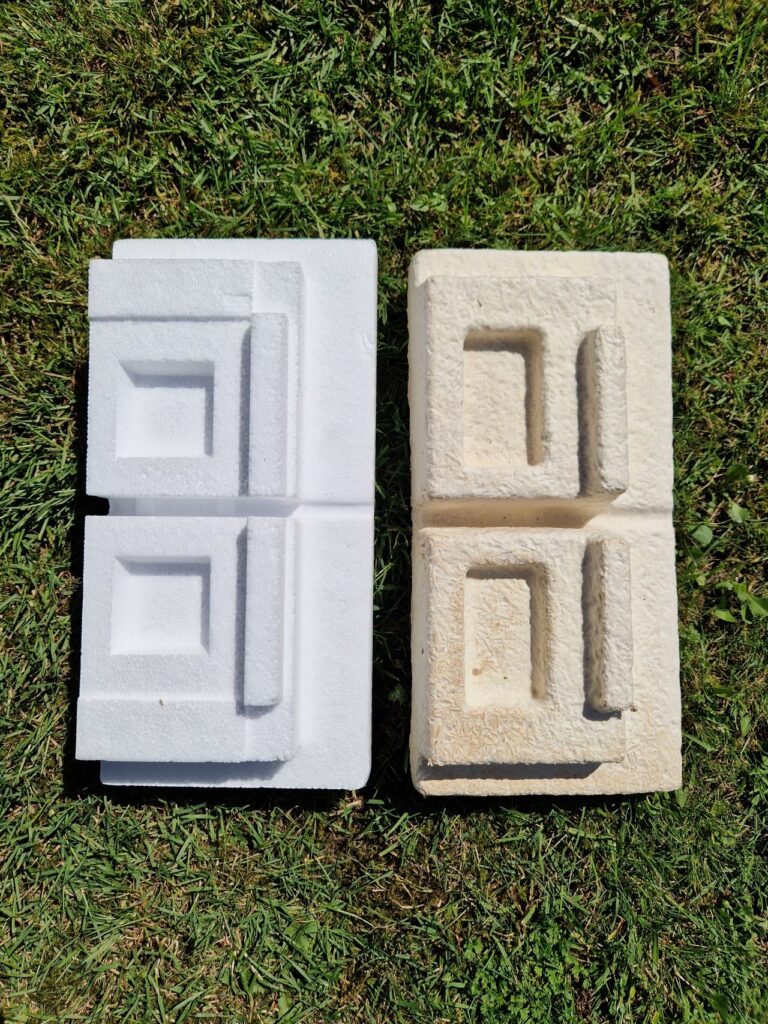
Heater packaging: EPS (left) vs. Mycelium Packaging (right)
Making the switch: why start now?
Transitioning to a new protective packaging material takes time. Prototyping, trialling, and integrating a new material into existing logistics can take months. Companies that begin the process now are better positioned to:
- Secure materials and manage lead times.
- Build internal confidence and expertise.
- Avoid last-minute scrambles as compliance deadlines (like the PPWR) approach.
The shift to sustainable packaging is about future-proofing your business, and with Mycelium Packaging, you can achieve both performance and sustainability.


 English
  German
  Dutch
Dutch